
Boston, Massachusetts: At the municipal sector’s current pace of rehabilitation and replacement, renewing the 4.6 million miles of underground water and wastewater pipes in the U.S. and Canada will take more than a century. As utilities face mounting financial pressure, trenchless solutions are emerging as one of the faster-growing segments of the market, with annual spend rising from US$8.8 billion in 2026 to US$14.2 billion in 2035.
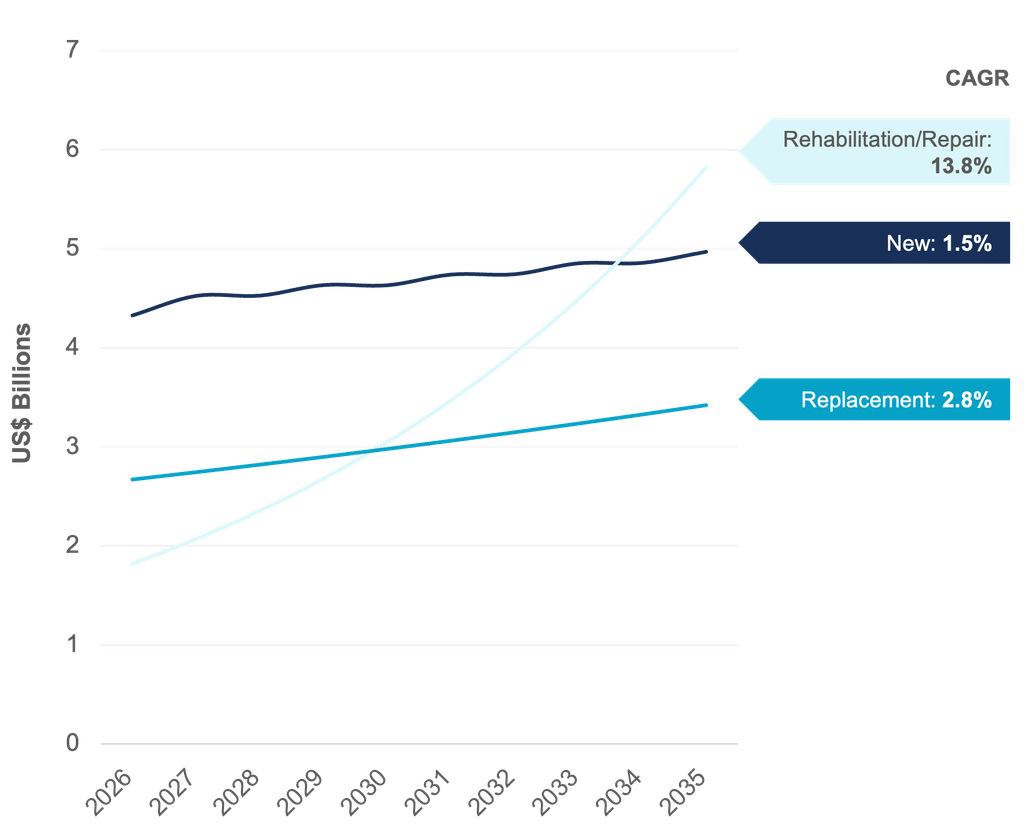
Bluefield Research’s new report, U.S. & Canada Water & Wastewater Trenchless Pipe Market: Drivers, Trends, and Forecasts, 2026–2035, forecasts municipal utility spend topping US$111.9 billion over the next decade. While topline annual spend will climb at a compound annual growth rate (CAGR) of 5.4%, rehabilitation-focused activities have a CAGR of 13.8%, significantly outpacing the broader market segment, including new, replacement, and rehabilitation/repair.
“Utilities can’t dig their way out of a century-long renewal backlog,” says Megan Bondar, an analyst at Bluefield Research. “The cost and disruption created by tearing up streets with traditional excavation methods is moving trenchless options further up the list of asset management strategies.”
Exhibit: Annual Trenchless Spend by Project Type, 2026–2035
Source: Trenchless Technology, Statistics Canada, Bluefield Research
Wastewater Leads, Drinking Water Is the Frontier
Wastewater networks account for 54% of trenchless spend, and the spend is growing faster, at 6.6% a year compared with 4.1% for drinking water. Further, over 89% of awarded projects via State Revolving Funds (SRFs)—a primary channel for federal funding for water and wastewater infrastructure—have focused on wastewater applications since 2020.
“Wastewater remains the more established market for trenchless applications, supported by a longer track record of deployment and fewer barriers to implementation. Drinking water presents a longer-term growth opportunity, but wider adoption will depend on addressing more demanding structural and regulatory requirements,” Bondar notes.
For Pipe Rehabilitation, CIPP Has No Real Rival
Of the three rehabilitation technologies Bluefield forecasts, cured-in-place pipe (CIPP) captures 81% of spend, or US$28.3 billion through 2035, leaving sliplining and spray-in-place pipe (SIPP) to split the remaining 19% between them. This makes suppliers of liners, resins, and curing equipment direct beneficiaries over the next decade. CIPP’s frontrunning role stems from a track record stretching back to the 1970s, and utilities are doubling down. Nearly four of every five dollars that the 20 biggest trenchless spenders plan to invest are going to CIPP.
Looking forward, ultraviolet (UV) light-cured liners are a technology to watch. A decade ago, high equipment costs and limited know-how kept UV CIPP on the margins. It now competes alongside conventional heat-cured systems, with western states emerging as a growth area. Because UV systems often use styrene-free resins, they could also open up opportunities to repair drinking water mains.
“With federal funding from the American Rescue Plan Act (ARPA) and the Infrastructure Investment and Jobs Act (IIJA) winding down, utilities need to squeeze more out of every dollar, which plays to the strengths of CIPP and other trenchless technologies. Vendors tout the ability to renew pipes at a fraction of the cost,” says Bondar.
Urban Markets Anchor Trenchless Demand
The addressable market for trenchless solutions is largely an urban story, given that large cities hold 58% of installed pipe and make up 76% of the trenchless forecast. Central to the trenchless advantage is the cost of closing streets, digging, and repaving. Speed compounds the advantage, tipping the economics toward trenchless.
Within the U.S., Texas, California, and Florida stand out across the forecasted spend. Texas makes up US$15.2 billion of the total because of large pipe networks and rapid population growth. Beyond these states, the U.S. forecast map splits by region. In the Northeast and Midwest, home to some of the oldest pipes in the country, renewal accounts for more than 70% of trenchless spend. The South and West lean more toward new construction. Canada also leans toward new construction and is the faster-growing market, at 6.1% a year versus 5.4% for the U.S. Within Canada, Ontario and Quebec lead rehabilitation and Alberta leads greenfield development.
“Canada offers a glimpse of where this market can go. Canadian utilities already use trenchless at higher rates than their counterparts south of the border, including CIPP on potable water mains, which is still the exception in most of the United States,” says Bondar.
About Bluefield Research
Bluefield Research provides data, analysis, and insights on global water markets, covering the municipal and industrial sectors across infrastructure, policy, and technology. As a leading provider of water market intelligence, Bluefield helps strategic decision-makers understand where the water market is going—and why.
The Insight Report, U.S. & Canada Water & Wastewater Trenchless Pipe Market: Drivers, Trends, and Forecasts, 2026–2035, presents a comprehensive analysis of the U.S. and Canada trenchless pipe market. It provides a data-driven perspective on how market drivers, forecasts, and regional dynamics are reshaping the landscape for investments in trenchless pipe projects. The full report is available for purchase and immediate download on Bluefield’s website.
