
6 May 2026, Boston, Massachusetts: U.S. and Canada’s municipal water utilities are moving beyond early digital adoption to system-wide deployment of connected infrastructure solutions and devices. This shift is driving digital water spend from US$14.4 billion today to US$28.6 billion by 2036, fueled by infrastructure asset failures, drought, and tightening regulatory mandates, according to Bluefield Research, a leading provider of global water market data and insights.
In a new report, U.S. and Canada Digital Water Landscape: Trends and Growth Forecasts, 2026–2036, Bluefield projects that spend on digital water solutions will total US$230 billion over the next decade, growing at a 7.1% compound annual growth rate (CAGR). This positions the digital water landscape as one of the most durable infrastructure investment opportunities in North America over the next decade, outpacing spend on traditional municipal hardware and equipment.
“Digital technology is reshaping every corner of the economy, and municipal water infrastructure is no exception,” says Leigh Ramsey, senior analyst at Bluefield Research. “It is important to note, however, that the pace of adoption varies significantly by system size, local pressures, and regulatory environment.”
Exhibit: U.S. and Canada Digital Water Forecast, 2026–2036
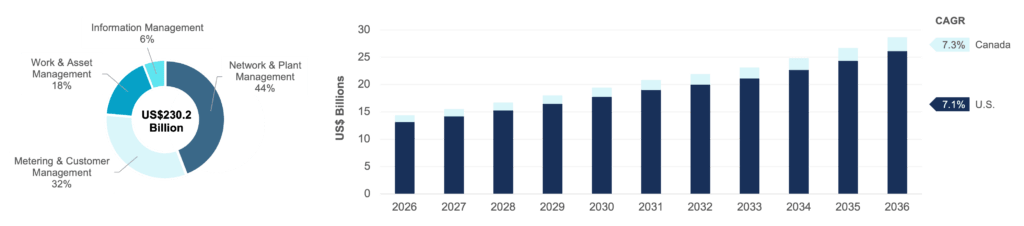
Source: Bluefield Research
Metering: From Visibility to Real-time Control
The share of smart meters is scaling rapidly, growing at a 9.7% CAGR compared to 2.6% for standard meters, as utilities recognize advanced metering infrastructure (AMI) as the foundational layer for digital operations. The shift gives utilities a real-time, two-way connection across customer networks, turning metering from hardware purely for billing into an operational intelligence platform that can support leak detection, more real-time demand management, and network-wide visibility.
Asset Management: From Reactive Maintenance to Predictive Operations
Asset management is the fastest-growing digital water segment in absolute dollar terms, expanding from US$2.3 billion to US$5.5 billion by 2036 (8.8% CAGR), signaling that utilities are increasingly rethinking how infrastructure is managed. Drones, advanced inspection technologies, and condition assessment tools are now enhancing, if not replacing, scheduled maintenance cycles with more continuous monitoring. This is giving utilities the data to prioritize capital investment where system risk is highest rather than where it is most visible.
Leak detection: From Monitoring to Intervention
Leak detection investment is expected to nearly quadruple over the next decade as water loss becomes a strategic liability. Contrasting approaches are being demonstrated across the U.S. with New York utilizing field crews to inspect 40,000 feet of pipe nightly, while Atlanta is rolling out more than 1,000 sensors for continuous, automated detection. Both methods reflect the same urgency, driven by fundamentally different approaches.
“Out West, utilities face persistent drought pressure, while Southeast utilities are managing high non-revenue water rates alongside population growth,” says Ramsey. “Leak detection is becoming essential infrastructure intelligence across very different regional challenges.”
Wastewater: From Compliance to Resilience
In January of this year, a major sewer overflow in Washington, D.C. released millions of gallons of untreated wastewater, highlighting the vulnerability of aging networks. Events like this are accelerating a shift from compliance-focused monitoring to resilience-driven operations, driving wastewater digital investment from US$1.2 billion in 2026 to US$2.8 billion by 2036. In Canada, Vancouver is doubling annual sewer inspections using digital tools to stay ahead of critical asset failures, representing a concrete example of how digital technologies are changing the calculus on infrastructure investment.
From Digitized Systems to Secure Digital Infrastructure
As utilities expand connected infrastructure, cybersecurity investment is forecast to nearly double over the next ten years. New regulatory frameworks, including requirements introduced in New York State, are formalizing cybersecurity standards across the sector. Information management is the fastest-growing digital water product category at a 10.8% CAGR, fueled by rising data volumes and compliance requirements that come with increasingly connected operations.
The next decade is not just about deploying more technology—it is about integrating it across utility operations that are often siloed and deeply entrenched. Those that successfully move from fragmented digital deployments to system-wide operational intelligence will define what the modern water system looks like, and which technology providers win the contracts to build it.
About Bluefield Research
Bluefield Research provides data, analysis, and insights on global water markets, covering the municipal and industrial sectors across infrastructure, policy, and technology. As a leading provider of water market intelligence, Bluefield helps strategic decision-makers understand where the water market is going—and why.
The Insight Report, U.S. and Canada Digital Water Landscape: Trends and Growth Forecasts, 2026–2036, provides a comprehensive, bottom-up forecast of the digital water landscape in the U.S. and Canada through 2036, covering hardware, software, services, and connectivity across every major technology segment. The full report is available for purchase and can be downloaded immediately from Bluefield’s website.
