
19 October 2026, Boston, Massachusetts: The U.S. municipal biosolids management market is projected to reach US$4.8 billion by 2035, even as growing scrutiny of per- and polyfluoroalkyl substances (PFAS) creates uncertainty over how wastewater utilities will manage and dispose of biosolids. With no federal PFAS standard for biosolids currently in place, a handful of states are developing their own rules, creating a patchwork of requirements that affects where and how money is spent across the industry.
“The traditional models for biosolids management in the U.S., including landfilling and landspreading, are under increasing pressure. Growing public awareness of PFAS in biosolids, increasingly stringent drinking water standards, and state-level regulatory activity are bringing greater scrutiny to conventional management practices,” says Pat Byrne, an analyst at Bluefield Research.
Bluefield Research’s new report, PFAS Management of Municipal Biosolids: A Shifting Regulatory Landscape, examines how policy and economic shifts are influencing local decisions. The emergence of PFAS concerns is adding cost and complexity that was unforeseen a decade ago.
States Take Different Approaches to PFAS in Biosolids
States are pursuing three main approaches to PFAS in land-applied biosolids: monitoring requirements, concentration-based restrictions (i.e., tier-based mandates), and outright bans on land application. However, the pace of change remains uneven across the nation.
Twenty-two states have no PFAS biosolids regulation or clear movement toward one, while states with existing frameworks differ in their testing methods, concentration limits, and land-application restrictions. These differences create compliance challenges for utilities and service providers operating across state lines.
In 2026, Massachusetts, New York, and Hawaii proposed bans that failed to advance, while tiered restriction models passed in Maryland, Virginia, New Hampshire, and Pennsylvania. Tiered approaches generally allow land application at lower PFAS concentrations while imposing tighter requirements as concentrations rise. Among states that have adopted these models, initial restrictions often begin at concentrations of 20 parts per billion (ppb) to 25 ppb.
“Legislatures and executive agencies in more than half of U.S. states have implemented or appear to be seriously considering new regulations for PFAS in land-applied biosolids,” says Byrne. “This represents an unusual level of regulatory activity for the sector.”
Exhibit: PFAS in Biosolids – State Regulatory Pathways
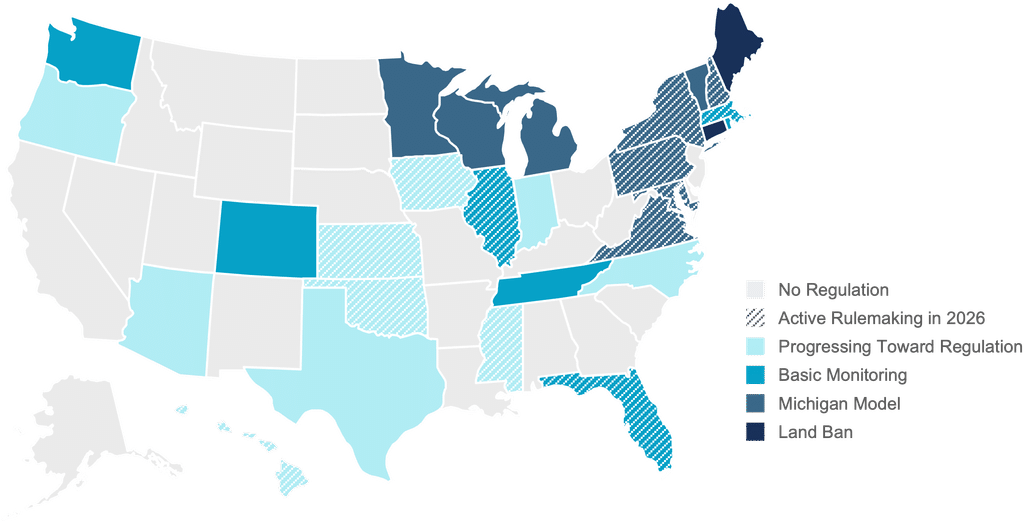
Source: Arizona, Florida, Oregon, and New York Legislatures, LegiScan, National Agricultural Law Center, North Carolina Department of Environmental Quality, Washington State Department of Ecology, Bluefield Research
PFAS Regulation Shifts Spending Toward Compliance and Disposal
Regulatory uncertainty presents significant challenges as utilities plan and budget for capital and operating expenditures. Bluefield’s analysis points to growing demand for testing, source control, dewatering, and hauling services that help utilities manage disposal costs and preserve multiple management options.
“Tiered restrictions may offer a more practical alternative to blanket bans, but they also heighten the need and cost for testing, compliance support, and measures to limit PFAS from entering wastewater systems,” says Byrne.
Larger biosolids management firms with access to disposal sites in lower-cost, less-restrictive states are at an advantage. However, differences in state requirements add compliance costs and complexity that could offset some of the competitive advantages. The direction of future spending depends largely on how states set their rules—whether utilities can continue using land application or must turn to alternative disposal methods.
Land Application Remains the Dominant Pathway
Despite growing scrutiny, land application remains a central part of U.S. biosolids management because it provides a relatively low-cost way to manage material while recycling nutrients and organic matter. There are currently no alternatives positioned to replace this practice at scale.
Landfilling is subject to constraints around material moisture and landfill tipping fees, while incineration capacity is also limited. Only 56 U.S. wastewater treatment plants operate sludge incinerators, concentrated largely in the Northeast and Midwest. Emerging technologies such as pyrolysis and gasification offer potential alternatives, but remain expensive and have yet to achieve broad commercial adoption for biosolids management.
“It is important to recognize that PFAS regulations are not eliminating land application or causing an overnight transformation of municipal biosolids management,” says Byrne. “Land application may become more restricted and costly for some utilities, but it is likely to remain an important management pathway for the foreseeable future.”
As states refine their approaches to this often overlooked part of wastewater treatment, utilities and service providers will need to balance compliance costs with the economics of available disposal options. The near-term market opportunity will center on helping utilities manage PFAS risks, control costs, and maintain flexibility rather than pursue outright changes.
About Bluefield Research
Bluefield Research provides data, analysis, and insights on global water markets, covering the municipal and industrial sectors across infrastructure, policy, and technology. As a leading provider of water market intelligence, Bluefield helps strategic decision-makers understand where the water market is going—and why.
This Insight Report, PFAS Management of Municipal Biosolids: A Shifting Regulatory Landscape, examines the structure and market effects of PFAS-related regulations and associated trends that are reshaping municipal biosolids management in the U.S. The full report is available for purchase and immediate download on Bluefield’s website.
