
17 August 2026, Boston, Massachusetts: Federal water infrastructure funding in the United States is set to fall roughly 63% between fiscal year 2026 and fiscal year 2027, dropping from US$23.4 billion to an estimated US$8.6 billion. But according to new analysis from Bluefield Research, a leading provider of global water market data and insights, the story behind this anticipated decline is more nuanced than the headline suggests.
Bluefield’s Data Insight, The U.S. Federal Funding Cliff: Sizing the Decline and Mapping the Exposures for States and Utilities, draws on Bluefield’s project-level analysis of 53,000 projects totaling US$136 billion across four federally supported programs: the State Revolving Fund (SRF), the Water Infrastructure Finance and Innovation Act (WIFIA), the American Rescue Plan Act (ARPA), and the Infrastructure Investment and Jobs Act (IIJA).
Each was created for a different purpose and under different policy conditions, and as the analysis shows, each operates on a different timeline. SRF and WIFIA are standing authorities that continue indefinitely as long as Congress funds them. ARPA and IIJA, by contrast, were built with fixed deadlines, and the fiscal year 2027 cliff reflects the simultaneous expiration of both funding streams.
- SRF programs center on a federal-state partnership that shifted water financing toward state-managed revolving funds. They continue as standing sources of low-interest loans and grants to local utilities for as long as Congress authorizes and funds them.
- WIFIA is a low-cost federal lending program, also a standing authority subject to ongoing appropriations, intended to leverage other sources of capital for large projects.
- ARPA provided emergency fiscal relief during the COVID-19 pandemic on a fixed, now-expiring timeline.
- IIJA delivered an unprecedented, time-limited US$55 billion infusion of federal capital into the water sector starting in 2022, with more than 80% of it channeled through the established state SRF programs rather than distributed as a standalone funding stream.
“At over US$130 billion, these programs have become major contributors to U.S. water infrastructure investment,” says George Prounis, Data & Insights Manager at Bluefield Research. “But they were never designed to do the same thing, and each faces its own challenges.”
Exhibit: Federal Water Infrastructure Funding by Major Program, 2010–2027
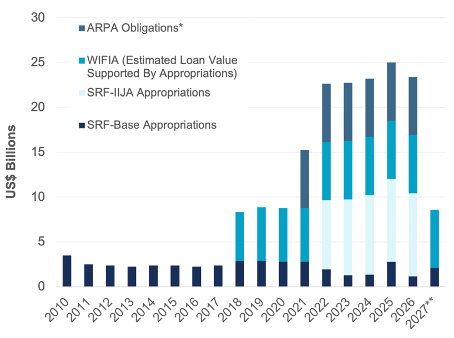
Notes: *Total American Rescue Plan Act obligations toward infrastructure projects (US$39 billion) were evenly spread between 2021–2026 for visualization purposes
**2027 estimate includes House-proposed fiscal year 2027 State Revolving Fund base appropriation and estimated loan amount supported by proposed fiscal year 2027 Water Infrastructure Finance and Innovation Act appropriation
Source: Bluefield Research
The federal funding decline should be viewed in the context of the broader financing structure of the U.S. water sector. According to the Congressional Budget Office, state and local governments accounted for 96% of U.S. water infrastructure investment in 2023, compared with 4% from the federal government. The 2026 to 2027 transition, therefore, marks the end of a five-year federal surge rather than a comparable contraction in overall water infrastructure investment.
ARPA Is the Only True Hard Stop
Passed in 2021, ARPA’s flexibility allowed states and localities to direct funding toward water and sewer infrastructure, but any funds not expended by 31 December 2026 revert to the Treasury. The resulting exposure varies by region: the South has received more than 50% of all ARPA water infrastructure obligations, totaling US$39 billion. Since 2021, sixteen states, including South Carolina and Mississippi, have drawn more water infrastructure funding from ARPA than from SRF or WIFIA, leaving them most exposed when the program winds down.
“Projects that cannot meet the deadline face the prospect of unused funds returning to the Treasury. For states and utilities that have leaned heavily on ARPA, the funding cliff is therefore not a distant 2027 issue—it is already a 2026 deadline,” Prounis explains.
SRF Funding Extends Well Past the Cliff
The State Revolving Fund programs—Clean Water and Drinking Water—were created in the late 1980s to shift federal water financing away from direct construction grants toward state-managed revolving loans, allowing a single federal dollar to support multiple rounds of investment over time. Of the US$40.7 billion in IIJA-backed SRF allotments, US$26.8 billion has yet to reach project-level agreements. Once capitalization grants are awarded to a state, they carry no firm expiration, and Bluefield’s analysis of the current award pace suggests IIJA-backed SRF funding will continue reaching water utilities into the early 2030s.
While the headline federal funding decline occurs between fiscal years 2026 and 2027, the pipeline of SRF funding already authorized under the Infrastructure Investment and Jobs Act will continue supporting projects well beyond 2027.
“For utilities and investors exposed to SRF-dependent states, the real question is how quickly the backlog is converted into projects, not simply what happens to federal appropriations in 2027,” Prounis adds.
WIFIA Was Never Tied to 2026
Established in 2014, WIFIA provides low-cost, long-term federal loans for large drinking water and wastewater projects. The program is designed to leverage a limited amount of federal funding into more substantial financing for major infrastructure investments. The value of WIFIA loans reaching financial close has steadily declined each year since peaking in 2021, as utilities have favored lower-cost municipal bonds and other instruments. With an average loan size of US$155 million, WIFIA remains concentrated among large borrowers: 21 states have never received a loan, while California alone accounts for 30% of the program’s total loan value.
Policy Risks Compound the Outlook
Beyond the program-level timelines, congressional earmarks diverted more than half of SRF appropriations in fiscal year 2026, converting revolving loans into one-time grants that erode the long-term lending capital designed to sustain state programs. Reauthorization of both SRF and WIFIA expires on 30 September 2026, and the House has proposed cutting the SRF base to US$2.1 billion for fiscal year 2027 with no IIJA supplemental layer.
“Not every state and utility faces the same cliff,” says Prounis. “Some still have a runway ahead of them, while others are already at the edge of one. The federal number tells you the total drop, but it doesn’t tell you which cliff you’re standing on.”
About Bluefield Research
Bluefield Research provides data, analysis, and insights on global water markets, covering the municipal and industrial sectors across infrastructure, policy, and technology. As a leading provider of water market intelligence, Bluefield helps strategic decision-makers understand where the water market is going—and why.
The Data Insight, The U.S. Federal Funding: Sizing the Decline and Mapping the Exposures for States and Utilities, utilizes Bluefield Research’s federal funding project databases to quantify the scale, structure, and geographic distribution of federal water infrastructure investment since 2021. The full Data Insight is available for purchase and can be downloaded immediately from Bluefield’s website.
