
09 March 2026, Boston, Massachusetts: U.S. household water and sewer bills hit a five-year high in 2025, rising 5.1% and outpacing inflation, according to Bluefield Research, a leading provider of global water market data and insights. Bluefield’s annual U.S. Municipal Water & Sewer Rate Index benchmarks utilities in 50 cities nationwide and reveals a 24.2% cumulative five-year increase—highlighting mounting cost pressures on utilities and ratepayers alike.
Household water and sewer rates are rising at different trajectories—and for different reasons. Water rates rose 6.0%, compared with 4.8% in wastewater rates between 2024 and 2025. Along with higher operating costs and regulatory requirements, drinking water costs are partly driven by supply-related investments—including imported water, reuse initiatives, and source water protection—as well as ongoing efforts to address water loss within distribution systems. In contrast, wastewater rates reflect the scale and complexity of treatment infrastructure, while also facing higher energy and labor costs. Despite rising more slowly, sewer service charges have exceeded those for water by an average of US$19.23 per month over the past five years.
“2025 marks a five-year high for year-over-year increase in combined water and sewer bills,” says Megan Bondar, an analyst at Bluefield Research. “Although rates are rising faster than consumer inflation, utilities are facing their own inflationary pressures, which are increasing the cost of maintaining and modernizing outdated infrastructure.”
Steep increases in electricity, treatment chemicals, construction materials, and financing costs are straining utility budgets—and ultimately, ratepayers. In 2025, Baltimore, Maryland, reported a 22% increase in the cost of water treatment chemicals and received a wastewater construction bid 14% higher than the original estimate. Similarly, Oklahoma City, Oklahoma, cited an 85% rise in electricity costs and a 155% increase in chemical expenses as factors underpinning its upcoming rate adjustment schedule. This has prompted some municipal utilities, like Houston, Texas, to directly link rate adjustments to inflation.
These trends reflect a longer-term pattern. Since 2000, the cost of water, sewer, and trash collection services has risen far faster than overall consumer prices. Between January 2000 and December 2025, prices for these services increased 207%, compared with 93% for overall inflation during the same period. Rising rates are translating into tangible household strain: covering a monthly water and sewer bill requires an average 11.5 hours of minimum-wage labor.
Exhibit: Household Water and Sewer Bills for 50 U.S. Cities, 2020–2025
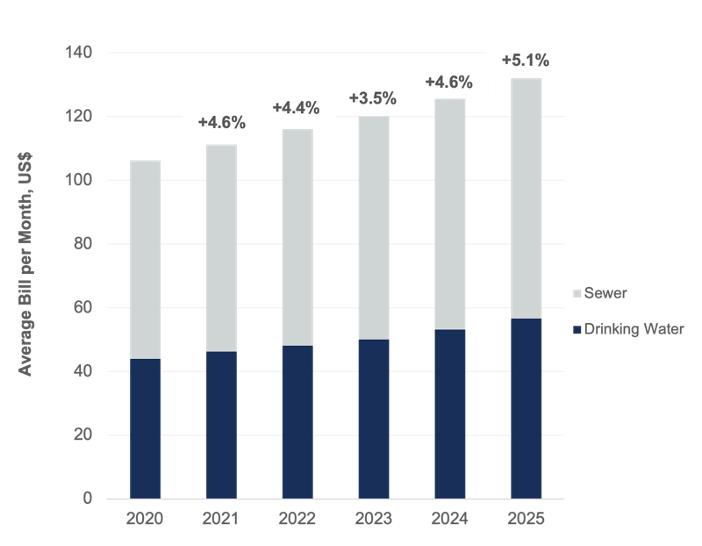
Source: Bluefield Research
Many utilities are responding proactively to affordability concerns. Cities including Seattle, Washington; San Antonio, Texas; and Philadelphia, Pennsylvania have implemented customer assistance programs (CAPs) offering bill discounts, lifeline rates for essential water use, and temporary financial support targeted by income, age, or veteran status. As a means of greater transparency, Fort Worth, Texas; Cleveland, Ohio; and Portland, Oregon, provide detailed public reporting that shows consumers how ratepayer revenues are allocated.
“Utilities that introduce rate adjustments gradually can help ease public concern and build greater consumer trust,” Bondar adds. “It is worth noting that five of the 50 utilities analyzed reported flat or declining rates.”
Rate pressures also vary widely across regions. Households in the Northeast (US$147) and West (US$143) face the highest combined monthly water and sewer bills on average. In parts of the West, utilities are increasingly investing in climate resilience measures such as flood protection infrastructure and seismic upgrades. In the Northeast, water quality concerns, aging infrastructure—including combined sewer systems—and higher energy costs are key drivers of investment.
“Utilities face difficult decisions about how to maintain reliable service while keeping water affordable for households,” says Bondar. “But with aging infrastructure, rising operating costs, and growing regulatory requirements, there is no indication that the upward trajectory in rates will change anytime soon.”
About Bluefield Research
Bluefield Research supports strategic decision-makers with actionable water market intelligence and data in the global municipal and industrial sectors. With expertise spanning infrastructure, policy, and technology, Bluefield helps companies understand where the market is going—and why.
Bluefield’s comprehensive analysis of drinking water and sewer rates for residents in 50 of the largest U.S. cities, representing approximately 20% of the U.S. population, underscores the critical need for innovative strategies to balance financial sustainability, equity, and resilience, ensuring the continued delivery of essential water services in the face of unprecedented challenges. Register here to access this complimentary data insight.
