
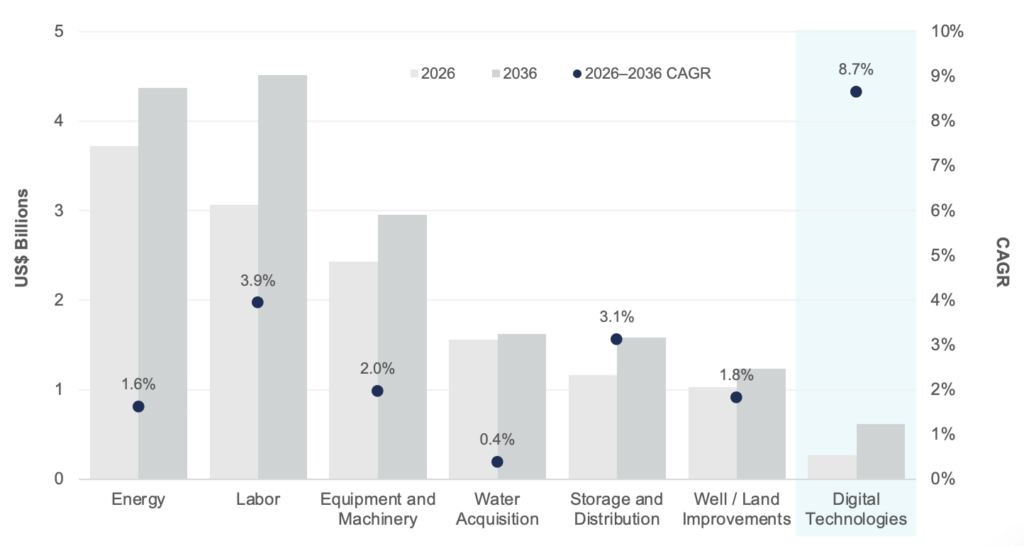
24 September 2026, Boston, Massachusetts: Digital irrigation technology is forecast to grow at a 10.2% compound annual growth rate (CAGR) through 2036, totaling nearly US$4 billion over the coming decade, according to Bluefield Research. This surge in growth is underpinned by water scarcity, rising energy and labor costs, and advances in digital technologies that are accelerating the adoption of data-driven water management across the United States.
Bluefield’s new report, Smart Irrigation: Data-Driven Control & Platform Integration for Water Management in U.S. Agriculture, finds that traditional irrigation is moving beyond basic controls toward more connected systems capable of monitoring weather and moisture conditions, optimizing watering schedules, and automating key decisions with site-specific data. “On-farm digital technology spend is significantly outpacing the broader irrigation market, and the pressure driving this growth is intensifying,” says Olivia Kranefuss, an analyst at Bluefield Research. “It’s growing at more than four times the rate of the top-line irrigation market.”
Energy and labor now account for approximately 62% of total irrigation operating expenses, and both have risen sharply over the past decade, on top of documented water scarcity and aquifer depletion that already threaten the long-term sustainability of agriculture in western U.S. states. Together, these pressures are driving farmer interest in digital solutions that reduce pumping time, offset labor, and demonstrate regulatory compliance.
Exhibit: Projected Growth of Digital Solutions Outpaces Mature Spend on Traditional Equipment
Source: Bluefield Research
Value Shifts From Point Solutions to Integrated Water Management Platforms
As the market moves from standalone sensors and controllers toward unified systems that monitor, schedule, and automate, the vendor landscape is shifting with it. Competitive advantage is moving to companies that own the connected workflow, not just whoever sells the most equipment. Some of the industry’s biggest and most traditional names are acting on that shift with real capital.
Lindsay acquired a minority stake in Pessl Instruments in early 2025 for US$7.3 million, folding Pessl’s soil probes and weather stations directly into its FieldNET platform, while Valmont consolidated four separate digital tools into a single unified app, AgSense 365, this year. Separately, Jain and Netafim are expanding their own software platforms for drip irrigation, a segment where automated control is spreading quickly. Rivulis is taking a different route, having turned its own software platforms over to Phytech in exchange for a minority stake, a bet that it can stay competitive on data without owning the software itself.
“The vendors winning that transition are the ones building partnerships or platforms that translate field data into automated action, not just hardware that collects it,” notes Kranefuss.
Beyond the Farm, a Slower but Distinct Opportunity in Water Delivery
The same shift toward connected, automated systems is reaching the irrigation districts and water-delivery organizations that move water to the farm gate, but this segment of the market moves at a different pace. Digital infrastructure spend for off-farm irrigation projects is projected to grow at a more modest 2.1% CAGR through 2036, and it’s highly concentrated. The largest 5% of water-delivery organizations account for more than 70% of digital spending.
The speed of change is also driven less by competition than by public funding. Automated gates and flow monitors are the fastest-growing categories, at 2.8% and 3.7% CAGRs, respectively, but adoption tends to move in fits and starts, tied more closely to state and federal grant cycles rather than to year-over-year annual budgets.
“Vendors can open up real opportunities in this market by aligning their sales pipelines with the federal and state grant cycles that districts use to fund large capital projects,” says Kranefuss. “Standard account models built around predictable annual budgets will miss most of the revenue.”
On the farm, the opportunity rewards a different kind of positioning: owning the full workflow rather than a single piece of it. “Digital water management is no longer simply about installing hardware,” adds Kranefuss. “The economics of agriculture are shifting quickly, from persistent water scarcity to volatile energy and labor costs, and the vendors that can bring integrated digital solutions to farmers while delivering practical technologies for modernizing water conveyance will be best positioned to capture the market’s growth.”
About Bluefield Research
Bluefield Research provides data, analysis, and insights on global water markets, covering the municipal and industrial sectors across infrastructure, policy, and technology. As a leading provider of water market intelligence, Bluefield helps strategic decision-makers understand where the water market is going—and why.
This Insight Report, Smart Irrigation: Data-Driven Control & Platform Integration for Water Management in U.S. Agriculture, presents a comprehensive analysis of the smart irrigation market. It encompasses market drivers, a 10-year forecast of nine digital product segments, and the strategies of leading companies. The full report is available for purchase and immediate download on Bluefield’s website.
