
10 August 2026, Boston, Massachusetts: The municipal pipe market in the United States and Canada is entering a new investment cycle defined by infrastructure renewal rather than network expansion, according to a new forecast from Bluefield Research. A recent housing construction slowdown, aging infrastructure, and shifting material preferences are reshaping utility capital spending priorities.
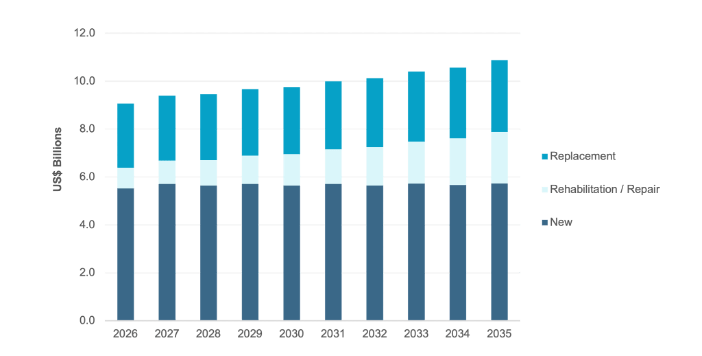
Bluefield’s new report, U.S. & Canada Municipal Drinking Water and Wastewater Pipe Forecasts, 2026–2035, projects municipal pipe capital expenditures to reach US$99.3 billion between 2026 and 2035. The analysis shows annual total CAPEX increasing modestly from US$9.07 billion in 2026 to US$10.88 billion in 2035, but rehabilitation and repair will nearly double its share of total investment, rising from 9.7% to 19.8%.
“Distribution and collection pipe represents roughly 45% of utility capital spending, making it the largest single infrastructure category in the sector,” says Reese Tisdale, President & CEO at Bluefield Research. “That scale makes shifts in utility investment priorities especially important. For manufacturers, contractors, distributors, and engineering firms, the opportunity is changing—not just in where demand emerges, but in the products, materials, and services utilities will prioritize over the next decade.”
Rehabilitation and Replacement to Grow Faster Than New Construction
Renewal-focused work is forecast to drive the next decade of pipe investments. While new construction remains the single largest investment category by dollar value, its share of capital spending declines as rehabilitation and replacement grow. This trend is fueled by an aging installed base of 4.52 million miles of water and wastewater pipe across the United States (94%) and Canada (6%), much of it approaching or past its design life. Two forces are driving this shift: a housing market that has plateaued well below its 2021 peak, slowing new build-out volumes, and asset age data that is converting into rehabilitation and replacement spend at an accelerating pace.
“Unfortunately, asset age doesn’t pause just because a capital budget does,” Tisdale explains. “Utilities that defer condition assessments and asset planning don’t avoid costs—they simply shift them from planned capital programs to emergency repairs and operating budgets.”
Exhibit: Pipe CAPEX by Project Type, 2026–2035 (Baseline)
Source: Bluefield Research
Plastic Displaces Traditional Materials in Sustained Multi-Year Shift
The shift from metal to plastic pipe is structural, not cyclical. Polyvinyl chloride (PVC) is expected to increase its share of total spend from 31.9% to 34.5% over the next decade, while ductile iron declines from 30.3% to 25.9%. The shift reflects a preference for lower-cost pipe in growth markets like the Sunbelt states, tempered by continued reliance on ductile iron in large urban centers. Specialty plastics are gaining share even faster than PVC itself: high-density polyethylene (HDPE) and molecularly oriented polyvinyl chloride pipe (PVCO) are both growing from smaller bases at a quicker pace. Tariff volatility adds a further layer of uncertainty across material costs.
“The material story is an old school, new school discussion,” Tisdale notes. “When property developers compare installation labor, corrosion resistance, and long-term maintenance, plastic pipe suppliers are winning more often than not. These economics aren’t likely to change anytime soon, irrespective of lifecycle costs.”
Scale and Growth Require Different Geographic Maps
Geographically, the pipe market opportunity is bifurcated. Texas, California, and Florida anchor roughly 28% of U.S. spend because of their large populations and relative pace of growth, while Wisconsin, Utah, and British Columbia, Canada are each growing faster than 3% annually, above the total market average of 2%. This highlights a distinction between markets that offer scale and those that offer above-average growth opportunities. Utah, for example, recorded both rapid urban expansion and significant rural population gains from 2010 to 2020, creating pressure on infrastructure across both settings.
In the U.S., the Northeast and the Midwest carry the oldest pipe networks and lean on legacy materials like ductile iron, while the fast-growing South and West have younger, plastic-heavy systems where shorter asset lifecycles will create earlier-than-expected replacement opportunities.
Utilities Anchor the Renewal Decade as Federal Funding Fades
Taken together, these shifts point to a decade defined by utility execution and portfolio alignment. U.S. Federal funding has proven to be less transformative for the pipe infrastructure market segment than anticipated. This is partly due to the pace of roll-out at the state level and the breadth of needs beyond hard infrastructure, including emerging contaminants like per- and polyfluoroalkyl substances (PFAS). Funding from the Infrastructure Investment and Jobs Act (IIJA) and American Rescue Plan Act (ARPA) is winding down, as prescribed, leaving utilities to rely on rate adjustments and other financial instruments.
Suppliers focused on rehabilitation, wastewater infrastructure, plastic pipes, and larger-diameter transmission will be better positioned for the market’s next phase. An uptick in housing starts and stable material costs will influence the market dynamics, but neither changes the underlying replacement need created by a well-established network aging faster than it is being replaced.
“Collectively, utilities are running the largest sustained capital planning exercise the water sector, if not the country, has seen in decades,” adds Tisdale. “While the market dynamics are evolving in a number of ways, vendors and contractors that show up with financing flexibility, more advanced condition assessment tools, and delivery capacity will be the ones that capture the greatest share of this investment cycle going forward.”
About Bluefield Research
Bluefield Research provides data, analysis, and insights on global water markets, covering the municipal and industrial sectors across infrastructure, policy, and technology. As a leading provider of water market intelligence, Bluefield helps strategic decision-makers understand where the water market is going—and why.
The Insight Report, U.S. & Canada Municipal Drinking Water and Wastewater Pipe Forecasts, 2026–2035, provides a data-driven perspective on how market trends, policy disruptions, and strategic pivots are reshaping the landscape for investments in pipe infrastructure. The full report is available for purchase and can be downloaded immediately from Bluefield’s website.
